
Every year, IndieWire surveys the documentary cinematographers at Sundance to find out what cameras they used. The results from the 2026 festival are in, and they tell a clear story about where documentary filmmaking is headed.
The headline? Sony dominates. The FX6 and FX3 sit at the top of the chart, appearing in more Sundance documentaries than any other cameras. Not ARRIs. Not REDs. Sony's compact cinema cameras. The ones that fit in a backpack.
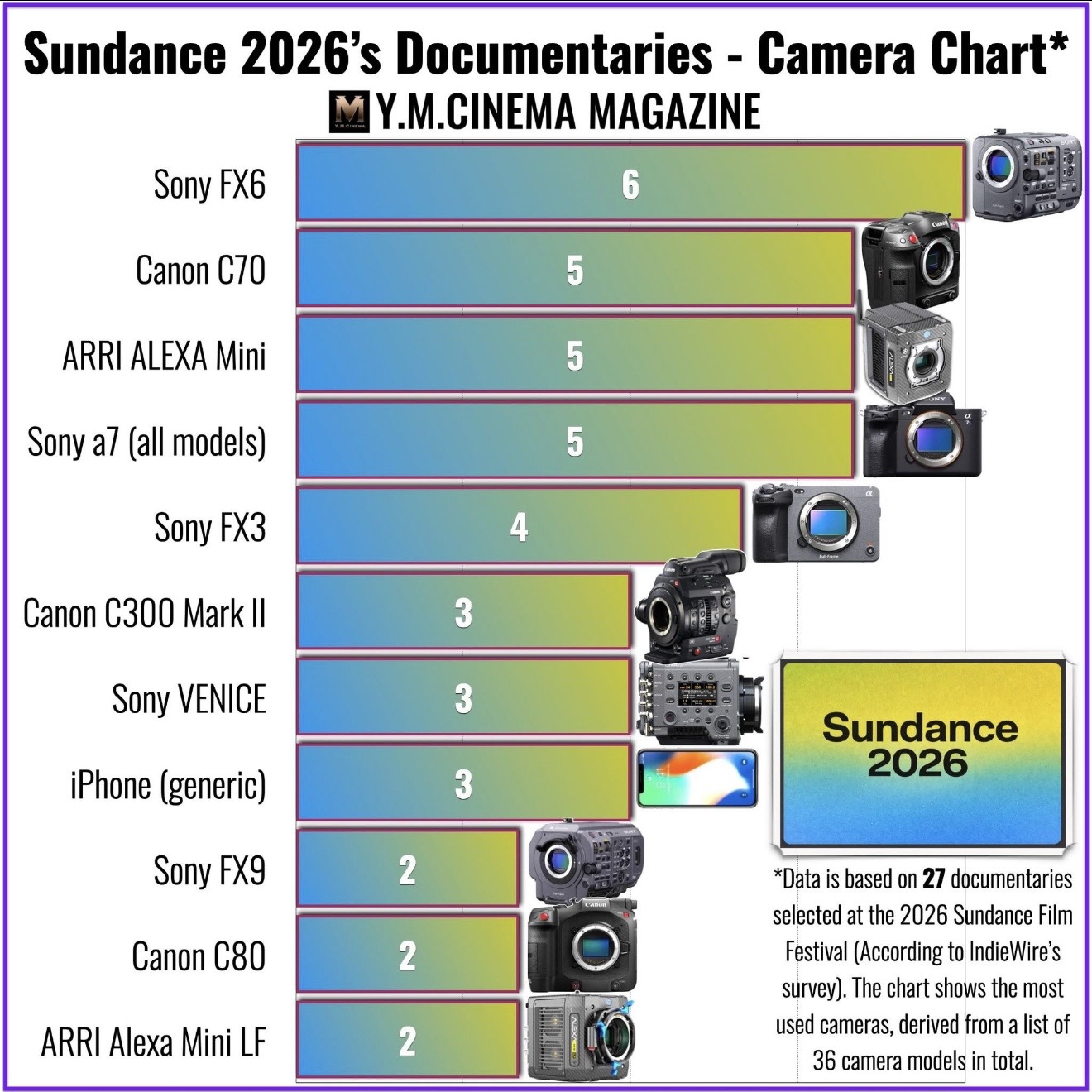
Data visualization: Y.M.Cinema Magazine / Survey data: IndieWire
Why Sony's compact cinema cameras are winning
The FX6 and FX3 share the same DNA. Both use Sony's full-frame sensor, both shoot in S-Log3 for maximum color grading flexibility, and both handle low light situations with remarkable clarity. The FX6 adds internal ND filters (which make a real difference when shooting outdoors), a larger body with more controls, and XLR audio inputs built in. The FX3 trades those features for an even smaller footprint and a lower price point.
What's interesting is seeing both cameras appear so prominently at Sundance. It suggests that documentary filmmakers are prioritizing mobility and discretion over traditional cinema camera features. When you're following subjects through their real lives, a smaller camera often gets you better footage than a larger one. People forget you're there.
The FX3 in particular punches above its weight
Four Sundance documentaries were shot on the FX3 this year. That's notable because on paper, it's positioned as a "content creator" camera. The body is tiny. There's no internal ND. The control layout is minimal. It looks more like a mirrorless photo camera than something you'd see at a film festival.
But the sensor inside doesn't care what the body looks like. When you pair it with the right glass and understand how to expose for S-Log3, you get footage that holds up on any screen. The dynamic range is there. The latitude in post is there. The filmic quality that separates cinema cameras from everything else is absolutely there.
We shoot everything on the FX3. Every project, every client. And here's my honest take: Miami heat is the real stress test for any camera. Humidity, direct sun, long shooting days with no AC. If a camera is going to fail you, it'll fail you here. The FX3 has never overheated on me. Not once.
My biggest gear regret? Not buying a second FX3 sooner. I was using a Sony A7R5 as my B-cam for interviews, and on paper it should work. Same sensor family, similar color science. But when it's hot outside, the A7R5 starts overheating, and you can see the difference between the two cameras in the footage. The A7R5 is a fantastic photo camera that happens to shoot video. The FX3 is a video camera, full stop. That distinction matters when a shoot goes sideways.
And shoots go sideways constantly. You show up with a plan, and then the plan gets blown up. The location changed. The subject is running late. The client suddenly needs vertical cuts for Instagram on top of the horizontal hero video. The FX3's size means I can adapt on the fly. Swap the rig, reframe for vertical, keep moving. Heavier cinema cameras don't give you that.
The gear should disappear. When you're not fighting your equipment, you can actually focus on the story.
What the Sundance data really tells us
Looking at the full chart, you'll see ARRI Alexas, RED cameras, and Blackmagic options scattered throughout. These are all excellent cameras. But the concentration at the top around Sony's FX line reflects something important: documentary filmmaking rewards flexibility.
A $50,000 camera package that requires a crew and permits becomes a liability when your subject's life takes an unexpected turn and you need to follow them somewhere new. A compact cinema camera that you can operate solo, that fits in a backpack, that doesn't intimidate the people you're filming... that's an asset.
This doesn't mean larger cameras are obsolete. For controlled documentary shoots with dedicated lighting and sound teams, they still have advantages. But the trend is obvious at this point.
Honestly, I wonder how much of this is generational. A lot of the filmmakers coming up now started on DSLRs or mirrorless cameras. They learned on small rigs. The big cinema camera doesn't feel like a step up to them. It feels like a hassle. That's a guess, not data. But I'd bet there's something to it.
The budget thing
I get asked about budgets a lot. And there's this weird gap in how people think about video production. Either it's cheap (someone's nephew with an iPhone) or it's expensive (a full crew, trucks, catering, the whole thing). Nobody talks about the middle.
The FX3 costs around $4,000. An ARRI Alexa 35 costs $70,000. Both cameras showed up at Sundance this year. I'm not saying they're identical. The ARRI is a different tool for different contexts. But the FX3 footage got into the same festival. That says something.
Side note: I find it funny that Sony markets the FX3 toward YouTubers and "creators" when it's clearly capable of so much more. Maybe that's intentional. Maybe they're just leaving money on the table. Either way, it works in our favor.
What this means for you
If you're considering video work for your brand or business, here's what this Sundance data actually means: the gear gap has closed. The cameras creating festival-winning documentaries are the same cameras we're using for client work. Not similar cameras. The same ones.
That doesn't mean every video will look like a Sundance documentary. Storytelling and craft still matter more than specs. But the equipment barrier that used to separate "professional" from "accessible" has basically disappeared. You don't need a massive production budget to get footage that holds up.
The FX3 and FX6 aren't going anywhere. They work. They're reliable. And apparently, they're good enough for Sundance.
The Short Version
- Sony FX6 and FX3 topped the Sundance 2026 documentary camera survey
- Four Sundance docs were shot on the FX3, a camera marketed to "content creators"
- The trend is clear: filmmakers are choosing compact, reliable tools over bigger rigs
- Festival-quality footage doesn't require a festival-sized budget anymore